
If you’re thinking about changing something about your smile, you’ve probably come across both dental implants and veneers. They are often mentioned together, particularly when people are researching ways to improve their teeth, but they are designed for very different purposes.
Understanding that difference is a useful place to start. From there, your oral health, what you’d like to change, how your teeth function and the treatment itself all need to be considered.
If you’re comparing dental implants and veneers, here’s a closer look at what separates them, who may be suitable for each, what can influence dental implants’ cost and veneers’ cost, and why your treatment plan shouldn’t be decided from a photograph alone.
First Things First: What Are You Actually Trying to Fix?
This is usually where the difference becomes clear.
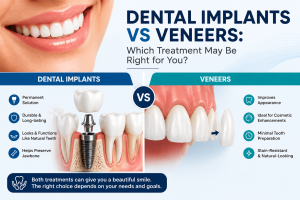
If you’ve lost a tooth, or a tooth can no longer be saved, a dental implant may be one of the options your dentist discusses with you. An implant is placed into the jawbone and, once the area has healed, supports a crown that replaces the visible part of the tooth. It is designed to replace the missing tooth rather than simply cover the space where it used to be.
Veneers are quite different. They are thin porcelain restorations bonded to the front of existing teeth and are generally considered a cosmetic treatment. Depending on your circumstances, they may be used to address concerns such as discolouration, minor chips, uneven edges, small gaps or variations in tooth shape.
That doesn’t mean every chipped or discoloured tooth needs a veneer. There may be other ways of addressing the concern, including tooth whitening, composite bonding or orthodontic treatment. This is why a proper assessment is important before deciding what you want to have done.

Dental Implants: Replacing What Is Missing
When a tooth is lost, the aim is not to simply fill the visible gap. Your dentist also needs to think about what’s happening underneath it.
Dental implants use a small titanium implant placed into the jawbone to provide support for a replacement tooth. Once the implant has integrated with the surrounding bone, a custom-made crown can be attached.
Whether this type of implant treatment is suitable depends on several things. Your dentist will look at the health of your gums and surrounding teeth, the amount and condition of the available bone, your general oral health and other factors that may affect healing.
Sometimes there isn’t enough bone in the area to support an implant as it stands. In those situations, additional treatment such as bone grafting may be discussed as part of the overall plan.
The important thing is that implant treatment is planned around the individual tooth and the person it belongs to, rather than following exactly the same process for everyone.
Veneers: Fixing What’s Already There
Veneers are generally considered when the tooth itself is present but there are aspects of its appearance that you’d like to change.
A veneer is bonded to the front of the tooth and can alter its colour, shape or proportions. They may be considered for teeth that are discoloured, slightly chipped, uneven or have small spaces between them, provided the teeth and surrounding tissues are suitable for treatment.
There is an important consideration here that is sometimes overlooked when people are comparing photographs online: veneers usually involve some preparation of the natural tooth. Even when only a small amount of enamel is removed, the process is considered irreversible.
Your dentist will therefore look at the health of the tooth, your bite and your expectations before recommending veneers. In some cases, another approach may make more sense.
Dental Implants and Veneers: How Do They Compare?
| Dental implants | Veneers | |
|---|---|---|
| What they do | Replace a missing tooth | Change the appearance of an existing tooth |
| Commonly considered for | Missing or non-restorable teeth | Concerns with colour, shape, minor chips or small gaps |
| How treatment is carried out | Implant placement followed by a restoration | Tooth preparation followed by veneer bonding |
| Treatment time | Usually involves several stages and a healing period | Often involves fewer treatment stages |
| Preparation | Requires surgical placement into the jawbone | Usually involves some preparation of the natural tooth |
| Cost | Depends on factors such as the number of teeth being replaced, the restoration required and whether additional treatment is needed | Depends on factors such as the number of veneers, material, preparation and complexity |
So, if you’re missing a tooth, a veneer isn’t going to solve that particular problem. The more important question is what your teeth need and what you’d like to change.
Which Treatment May Be Suitable for You?
There isn’t a checklist that can tell you this without a proper consultation.
Your dentist will look at your teeth, gums, bite, available bone and overall oral health, while also considering what you’d like to change. This helps determine which options are clinically appropriate and whether implants, veneers or another treatment may be more suitable.
From there, a personalised treatment plan can be developed around your individual circumstances, rather than starting with a particular procedure and working backwards.
What About the Cost?
It’s perfectly reasonable to want to know about the cost before committing to dental treatment. The tricky part is that neither the cost of dental implants nor the cost of veneers can be reduced to one standard figure.
With dental implants, the cost can depend on the number of teeth being replaced, the type of restoration required, the complexity of the implant procedure and whether additional treatment, such as bone grafting, is needed.
With veneers, the number of teeth being treated, the material used, the preparation involved and the complexity of the changes can all affect the overall cost.
And because implants and veneers do completely different things, comparing the two simply by price doesn’t tell you very much. Once your dentist has assessed your teeth and discussed your options with you, they can explain the treatment involved and the associated fees.
A Few Things to Consider Before You Decide
Both treatments have potential risks and limitations, and it’s important to understand them before making a decision.
Dental implant treatment involves surgery, so there can be risks such as infection, bleeding, discomfort, delayed healing or failure of the implant to integrate with the bone. Depending on where an implant is being placed, there can also be a risk of changes in sensation involving nearby nerves. The implant and the crown it supports will also need ongoing care.
Veneers require preparation of the natural tooth, making the treatment irreversible. Some people experience sensitivity afterwards, while veneers can chip, fracture, loosen or become worn over time. They may eventually need repair or replacement.
The lifespan of either treatment can vary, too. Your oral hygiene, bite, general dental health, lifestyle and the way you care for your restorations can all play a part.
So, What’s Right for You?
If you’re looking at dental implants and veneers, the first step shouldn’t be choosing one.
Start with what’s happening with your teeth and what you’d like to change. Your dentist can then assess your oral health, talk you through the options and explain what each treatment involves, including its potential benefits, limitations, risks and costs.
For one person, that may lead to implant treatment. For another, veneers may be more appropriate. Someone else may be better suited to a different form of cosmetic treatment altogether.
A consultation will give you the opportunity to make a decision based on your own teeth, rather than trying to work it out from someone else’s smile.
If you’re considering dental implants, veneers or another cosmetic treatment, speak with our team about arranging a consultation.